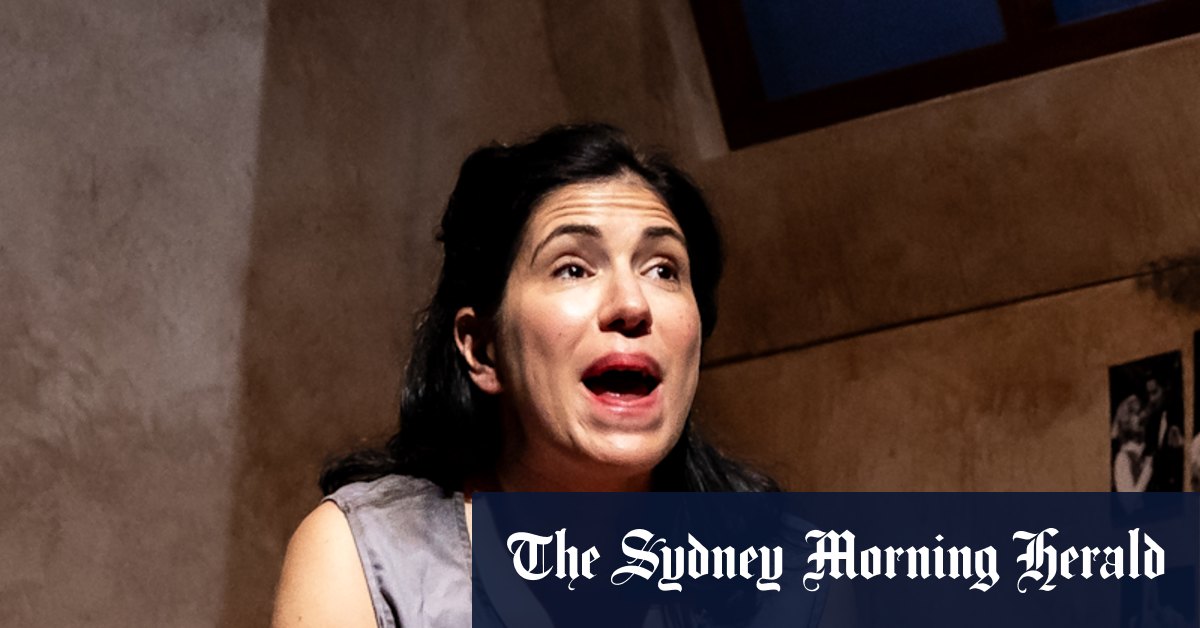
It is Frank’s most harrowing experiences that she demands her editor include. But Bow Tie wants to appeal to young readers. He wants her innocence retained.
Loading
Whose truth gets told is a key theme in the play, but it’s presented as a straw-man argument between the well-realised Frank and a caricatured editor.
Playwright Ron Elisha was inspired to write this polemical piece after reading an essay by American Dara Horn that questioned why the Diary of Anne Frank, with its hopeful final line, has been so successful. Horn argued that the diary lets readers off the hook, offering facile forgiveness while bypassing darker complexities.
The Frank presented on stage is far from the poster girl for forgiveness. She’s filled with rage and hate at what she’s experienced.
This is a demanding show in which the versatile Fishman plays all the roles, including Bow Tie and the camp guard. She is a powerful and nuanced Frank, as she evolves from innocent teenager to a woman burning with fury and fighting to tell her unvarnished tale.
Amanda Brooke Lerner’s direction makes shifts of time and place clear, and the most confronting scenes are sensitively handled.
Jacob Battista’s static set evokes the three locations with a sparse wooden bed conjuring the camp. At one side is the Amsterdam attic, on the other the editor’s book-lined office and wooden desk. The location and tone shifts are aided by Finnegan Comte-Harvey’s effective lighting.
This is a bleak, thoughtful piece that comes against a backdrop of rising conflict, not only in the Middle East.
It offers no easy solutions or plea for peace. Yet if we shred the idea of a humanity capable of good, where does that leave us? In a world unable to escape our escalating savagery.
THEATRE
TRENT DALTON’S LOVE STORIES
Riverside Theatres, September 12
Until September 20
Reviewed by KATE PRENDERGAST
★★½
If you chanced to walk by a Brisbane street corner in 2021, you may have come across Trent Dalton, Walkley-winning journalist and our nation’s current literary golden boy. He’s sitting behind a sky-blue 1960s Olivetti typewriter with a sign reading “sentimental writer collecting love stories”.
With (at least according to the dramatic interpretation) crinkly eyes and a boyish smile, he invites you and every other regular bloke and missus passing by to tell him their own personal love story. Those true-blue anecdotes became Love Stories, the book, which was adapted by Tim McGarry into a cine-theatrical and wildly popular Brisbane Festival and QPAC show. It is playing in Parramatta this month on its five-city tour, directed by Sam Strong.

Live video is a necessary distraction and stimulation.Credit:
It was of course Boy Swallows Universe that catapulted Dalton to literary stardom. Writing in relentless aphorism, with plots that heave with romanticism and old-school Aussie nostalgia, reading Dalton feels like a bad-taste populist parody, as unpleasant as popping candy.
That’s just one opinion, though, and seemingly a minority one. Along with the vulture reviewers, Love Stories’ PR team invited a flock of book influencers to opening night, with a shameless plug of Swallows in the play itself.
Loading
Jason Klarwein is our dramatised Dalton, sitting at that street corner with his Olivetti, ear cocked towards the plangent sound of the common man’s heartstrings. The play is structured as a relentless whirlwind of bite-size profundities and platitudes, with dozens of characters relaying their deepest truths, then disappearing into the skin of another through their respective actor. All stories get a screen subtitle in large, typewriter font.
Live video that captures both on-stage actors and sometimes the audience is a necessary distraction and stimulation. The play would feel very flat without this technical virtuosity, which sometimes deploys overlays, delays and other special effects, and makes much use of the dramatic close-up. There is also some contemporary dance.
Love Stories on stage reproduces the numbing sensation of watching a TikTok feed with the algorithm set to “Big Feelings”. There are stories of lovers who die in car crashes, and lovers who propose in flash mobs; love as a perfect sub/dom pairing, and love as a Rwandan genocide orphan found under a tree.
There’s love as childhood friendship, and love as finding “three good things” to survive each day. That last story, inhabited by Hsin-Ju Ely, was almost moving. And it’s true the cast of 10 makes the most of the material, with standouts in Rashidi Edward, Valerie Bader and Kirk Page.
The show is not without self-awareness. The narrative through-line is character-Dalton’s own love story – which is far past the honeymoon stage. With his wife (Anna McGahan) understandably frustrated at the sacrifices she’s made so her husband can bum around Brisbane’s CBD and listen attentively to everyone but her, she’s put herself in therapy. This central story provides welcome continuity and some sharp rebuttals to the schmaltz.
It all wraps up nicely by the end of course, with a wedding ring remade. What’s not to love? See previous.
THEATRE
TRUE WEST
Ensemble Theatre, September 12
Until October 11
Reviewed by JOHN SHAND
★★★★½
Simon Maiden’s Lee creates a tension thick with latent violence, a black hole of negative energy. His blank eyes stare with hate and resentment. “You go ahead, like I wasn’t even here,” he tells his brother Austin (Darcy Kent), who’s trying to write a screenplay, but Austin may as well try to imagine a world without sibling rivalry.
In Sam Shepard’s supreme 1980 play True West, Lee, the elder brother, is the daredevil, wastrel and lost soul capable of physical violence and minor criminality. He lobs in on the college-educated, mild-mannered Austin, who’s house-minding – plant-minding, primarily – for their mother while she’s in Alaska. Austin’s using her southern California bungalow as a writer’s retreat to nail down a love story that already has interest from a producer, Saul (James Lugton).

James Lugton, Simon Maiden and Darcy Kent in True West. Credit: Prudence Upton
But hard-drinking Lee has a story of his own, and he gazumps Austin by selling Saul on the idea of a modern-day western that’s one big chase sequence – a metaphor (although he doesn’t know it) for the lifelong game of chase the brothers have been playing.
I can’t imagine three consecutive nights of high-calibre theatre more disparate than the oneiric Orlando (Belvoir St), the bluegrass poignancy of Bright Star (Hayes Theatre) and then True West. If you only see one, make it this. It’s directed by Iain Sinclair, who did the Ensemble’s memorable The Caretaker three years ago, and there are overlaps between Pinter and Shepard. They both like characters who struggle to communicate, and whose frustration breeds aggression.
Shepard consummately structures his play so that when Austin joins Lee on his drinking binge (after Saul favours Lee’s movie idea), the gulf between their characters shrinks until the similarities seem to outweigh the differences. But that only masks underlying resentments.
Maiden and Kent are riveting, walking the seesaw of power imbalance between them. There’s a moment late on when Kent is on his knees, staring up at Maiden, his performance so potent you can see in his eyes the ghost of the hero-worship he once had for his brother.
Lugton’s Saul is the sunbeam of humour blazing through the storm clouds in a wide-collared paisley shirt and perfectly pressed cream trousers (courtesy of designer Simone Romaniuk). Lugton adds matching bonhomie and bravado – at least in Saul’s dealings with Austin. Lee can’t so easily be tamed by smiling promises.
Alas for the brilliant Maiden, a medical emergency forced him from the stage near the end, halting the show for 20 minutes, after which Sinclair read Lee (in costume), and commendably saw the fraternal war to its inevitable conclusion.
This includes the unexpected return of the boys’ mother, played by Vanessa Downing, who probably didn’t have to work too hard to be in a state of shock after what had happened to Maiden, and who completed a stellar cast fulfilling Shepard’s manic vision: a snapshot of an America that can tear itself apart.
MUSIC
A Musical Awakening
Australian Chamber Orchestra, September 17
Reviewed by PETER McCALLUM
★★★½
The program opened and closed with musical meditations on hymn-like melodies that evoked a search for serenity and transcendence that became the concert’s dominant theme. The first piece, Illuminations, grew out of a soundscape by Erkki Veltheim, which could be heard in the foyers and hall as listeners arrived.
Birdsong, wispy rustling and cavernous wind sounds created the ambience of daybreak and moved seamlessly into a performance by recorder player Genevieve Lacey of Hildegard von Bingen’s 12th-century chant Ave, Generosa. Lacey was quietly accompanied by ACO members playing sustained notes, scurrying figures and fragments of the hymn, which lingered like shapes imprinted on the retina after the object has gone.

Genevieve Lacey and theorbo player Simon Martyn-Ellis.Credit: Charlie Kinross
On the Nature of Daylight by Max Richter continued without a break with theorbo player Simon Martyn-Ellis providing delicate decoration and incisive bass notes to a chorale-like harmonic progression that began on cellos and swelled to the entire string orchestra.
Wiima by Finnish composer Jaakko Kuusisto (whose Cello Concerto the concert’s director Timo-Veikko Valve played to such striking effect earlier this year) broke abruptly from the meditative mood with an initial jabbing, thick chord. This turbulent work juxtaposed surging wind-like textures with penetrating solos and rhapsodically expressive recitatives, closing with an angular rhythmic passage that culminated in a frantic expressive moment.
David Lang’s flute and echo (receiving a world premiere) was, on the surface, exactly what the label said. Lacey played a hauntingly resonant arabesque on one of the lower pitched recorders, which was echoed with some details trimmed by lead violinist Helena Rathbone and then further abridged by the rest of the orchestra.
Lacey retained rounded warmth to the sound as she played progressively higher instruments and the “echoes” fragmented further. When, at the end, she returned to the opening arabesque the surrounding echoes drifted off with their own textures as though cut free.
After interval Melody Eotvos’s Meraki (a Greek word meaning, in her words, when you “put something of yourself” into what you are doing), built up a dark bed of sound from low strings. The piece also had hymn-like moments mixed with passages of tussling rhythmic vigour.
In Imaginary Cities: A Baroque Fantasy , Veltheim created another soundscape against which Lacey led the orchestra in music from the Venetian Baroque by Monteverdi, Vivaldi and Strozzi. It provided an opportunity to hear Lacey chirp with agile virtuosity on a high-pitched recorder in Vivaldi’s Recorder Concerto in C major.
The closing work, Beethoven’s Heiliger Dankgesang (Holy Song of Thanksgiving) from the String Quartet in A minor, Opus 132, took on a sad and solemn significance as a tribute to the passing last Saturday of John Painter.
Beginning his career in the SSO under Eugene Goossens, Painter is fondly remembered and revered by generations of Australian musicians, as cellist, teacher, Director of the NSW State Conservatorium (as it was then called) and the Canberra School of Music and as founder of the ACO fifty years ago.
MUSICAL THEATRE
BRIGHT STAR
Hayes Theatre, September 11
Until October 5
Reviewed by JOHN SHAND
★★★★
Don’t necessarily judge a musical by its soundtrack. The original Broadway cast recording of Bright Star suggested I was in for a long night. The music and lyrics, by Steve Martin and Edie Brickell, are in a bluegrass/country vein, evoking the setting in North Carolina’s Blue Ridge Mountains. The songs sounded samey, the singing ordinary, and perhaps there was a good reason why nobody had penned a bluegrass musical before.
But that didn’t allow for Steve Martin’s book, with its sharply drawn characters, wit and poignancy – as well as unabashed melodrama – melodrama having kept country ballads simmering since folks first donned cowboy boots.

Bright Star is Sport for Jove’s first musical. Credit: Robert Catto
It also didn’t allow for the Broadway album’s singing being completely outgunned in a production devised, improbably, by leading Shakespeare company, Sport for Jove. Why, I’d wondered, would Sport for Jove lower the bar to hick musical theatre? Now I understand.
Although this is the company’s first musical, music has long been key to its Shakespeare productions, and Bright Star burnishes rather than clouds its reputation. Directors Miranda Middleton and Damien Ryan and musical director Alec Steedman have assembled a 16-person ensemble, almost all of whom act, sing, dance and play. It seemed only three band members didn’t have a character to play, and only one cast member didn’t play an instrument.
That was Hannah McInerney in the pivotal role of Alice Murphy. She has two especially potent songs, Please Don’t Take Him and At Long Last, and they would test the ability of any female singer not to become shrill while squeezing out the show’s emotional marrow. McInerney was superlative – and also acted her socks off as a literary magazine editor whose newborn babe was ripped from her arms 23 years before.
The show zigzags between 1946 and 1923 with an abruptness that initially teases, but we get our heads around it, and learn to trust Martin’s storytelling and invest in his detailed characters. In an ensemble of co-leads, the expert actors included Cameron Bajraktarevic-Hayward, Kaya Byrne, Jack Green, Sean van Doornum, Katrina Retallick and Rupert Reid.
Special mentions must go to Deirdre Khoo, who maximises the minor role of Lucy most entertainingly, and Genevieve Goldman (Margo), who has an ideal voice for the material, and who, upon learning that her love interest, Billy, is being published by Alice’s magazine, performs a little dance of exquisite ecstasy.
The lively choreography by Shannon Burns dovetails with the whip-crack directing, including such joy as a door held up to be knocked on, which, upon being opened, magically becomes a dining table. Designer Isabel Hudson cunningly implied the prevailing rusticity while accommodating 16 performers on the tight stage.
Yes, the melodrama undid certain moments, and the redemptive storyline was predictable, yet all was animated by the music’s high energy under Steedman’s direction and Victoria Falconer’s onstage supervision.
MUSICAL THEATRE
HERE YOU COME AGAIN
Theatre Royal, September 13
Until October 18
Reviewed by JOYCE MORGAN
★★★
The towering blonde wigs, the eyelashes, the rhinestones. And that’s just the drag queens in the front stalls.
This fanfest was always going to draw Dolly Parton’s most flamboyant admirers.
It’s more tribute show than fully fledged musical, so don’t look for insights into Dolly or even much about the life of the fiercely talented singer/songwriter, Tennessee-born musician.

Tricia Paoluccio delivers an impeccable, sparkly Dolly.Credit: Cameron Grant
Fortunately, the star of this show delivers an impeccable, sparkly Dolly. Tricia Paoluccio captures Dolly’s clear, bright voice, southern drawl and warm-hearted spirit. Whether acting lines or singing from the extensive Parton songbook, Paoluccio channels her idol.
Threaded through this jukebox musical is a slender story about Dolly-tragic Kevin.
Set amid the COVID pandemic, the 40-year-old has moved into his parents’ attic. Kevin’s career is on the skids, and his boyfriend has dumped him. Surrounded by stockpiled toilet rolls (remember that pandemic phenomenon?), Kevin is hoofing into the booze and Cheezels.
“What would Dolly do?” he wonders. And, hey presto, she materialises – a vision in a pink frock and rhinestones. This is Dolly as fairy godmother.
She’s come to set Kevin’s world to rights, help him restore his confidence and impart some homespun wisdom.
What follows is a string of Parton numbers, her big hits – Here You Come Again, Jolene, Islands in the Stream, I Will Always Love You – and some lesser-known. These were well delivered, if not well integrated into the story.
Taking a musical icon and spinning a tale around that figure can work brilliantly, as Titanique showed with its conceit that Celine Dion was on the doomed ship. But to succeed, the writing needs to be sharp and the story fleshed out.
Here, the sections between the music sagged, especially in the first half as Kevin wallowed endlessly in his misery. As Kevin whined and Dolly retorted with more homespun wisdom than a crate of Hallmark greetings cards, by interval the repetition was deflating.
The stronger second half kicked off with Nine to Five, which literally raised the tempo. Dolly’s trademark wit was also more evident, as she poked fun at country and western songs replete with dead dogs and tragic romances.
The Queen of Country, now on the cusp of 80, gave her blessing to this musical, first staged in the US in 2022. Co-created by Paoluccio, Gabriel Barre (who also directs) and Bruce Vilanch, it’s been lightly adapted for an Australian audience by Fiona Harris and Mike McLeish, with Kevin’s attic set in Bendigo.
Dash Kruck was an overwrought Kevin but dialled back the shrillness later in the show. Vocally, he was well-paired with Paoluccio.
The seven-piece band under Andrew Worboys’ musical direction was tight as they moved around and above Paul Wills’ attic set. Several of the musicians also played minor roles.
A happy ending is as assured as a mega-mix. One for the fans, this show is as light and saccharine as candy floss.
Leave a Reply